Posts tagged with “academia”
Academic site
I now have a home page over at the University of Bath, where I’m doing my PhD. It’s just for academic things and lists of publications. Find it here: cs.bath.ac.uk/~cajw20.
Workshop on Algebra, Coalgebra and Topology
I’m a local organiser for the Workshop on Algebra, Coalgebra and Topology (part of the Wessex Theory Seminar) which will be held at the University of Bath on March 1st 2013. More details on that page to which I just linked. Email me if you’d like to attend (registration is free). Proceedings will be published in ENTCS if enough people submit.
Embedding a Bibtex publication list in a website with PHP
Now that I have a more professional website, I wanted to include on it a list of publications. It took me a while to figure out a “good” way to do this, and many things I tried didn’t work, so here’s the solution I eventually settled on.
Maybe it can help you too!
OHBM 2016
Writing this report was one requirement of the travel grant which let me attend this conference. Having written and hyperlinked it up, I thought I’d post it in case it would be of interest to anyone. At least check out the videos!
2016 was the second time that I visited the Annual Meeting of the Organization for Human Brain Mapping, this time to present the poster 3682: Investigating human speech recognition: Reverse-engineering the machine solution with EMEG and RSA, co-authored by my colleagues at the Departments of Psychology and Engineering at Cambridge. The visit was generously supported by a Brain travel grant, for which I give my thanks.
Working as a postdoc at Lancaster University
I’ve just started a new job at Lancaster University, working as a postdoc in Louise Connell’s lab. I’ll be looking at the roles of linguistic representations and sensory simulations in human cognition. You can read more about the lab’s research aims on its website.
Update: Louise has now moved to Maynooth University, and the old lab’s page at Lancaster has ceased to exist. But you can easily find out the kind of things Louise’s colleagues worked on at her new page.
New paper: "Relating dynamic brain states to dynamic machine states: Human and machine solutions to the speech recognition problem"
Hey!
I just had a paper published in PLOS Computational Biology. It’s on some work I did with the Centre for Speech, Language and the Brain at Cambridge University. In it, we used a machine model of speech recognition to map phonetic sensitivities in human auditory cortex using magnetoencephalography neuroimaging data.
The paper is open-access, so you can read it here.
If you’re interested, you can read more about the kind of research I do over at my “professional” website.
New(ish) paper: "Entrainment to the CIECAM02 and CIELAB colour appearance models in the human cortex"
Not so long ago I had a paper published in Vision Research. It’s on some work I did some years ago with my friend and collaborator Andrew Thwaites. In it we look at the entrainment of magnetoencephalographic activity in early visual cortex to colour information in visual stimulus using two competing computational models of colour. In other words, when and where people’s brainwaves directly track the colour of moving images they were seeing on a screen, using two theories about how colour could be represented in the brain.
The paper is in Elsevier’s “open archive”, which hopefully means you can read it for free. If not, hit me up.
I don’t talk about my work too much here, but if you’re interested you can read more about what I do on my more professional website.
New preprint: "Understanding the role of linguistic distributional knowledge in cognition"
I have recently submitted a paper based on some work I have been doing at my job at the Embodied Cognition Lab at Lancaster University. In it, we look at a large set of linguistic distributional models commonly used in cognitive psychology, evaluating each on a benchmark behavioural dataset.
New preprint: "Linguistic Distributional Knowledge and Sensorimotor Grounding both Contribute to Semantic Category Production"
My colleagues Briony Banks, Louise Connell and I recently submitted a paper reporting research we’ve been doing at Lancaster University over the last year.
Needless to say, the Covid-19 lockdowns in the UK have been a substantial impediment to this work, so it’s really good to see it finally complete.
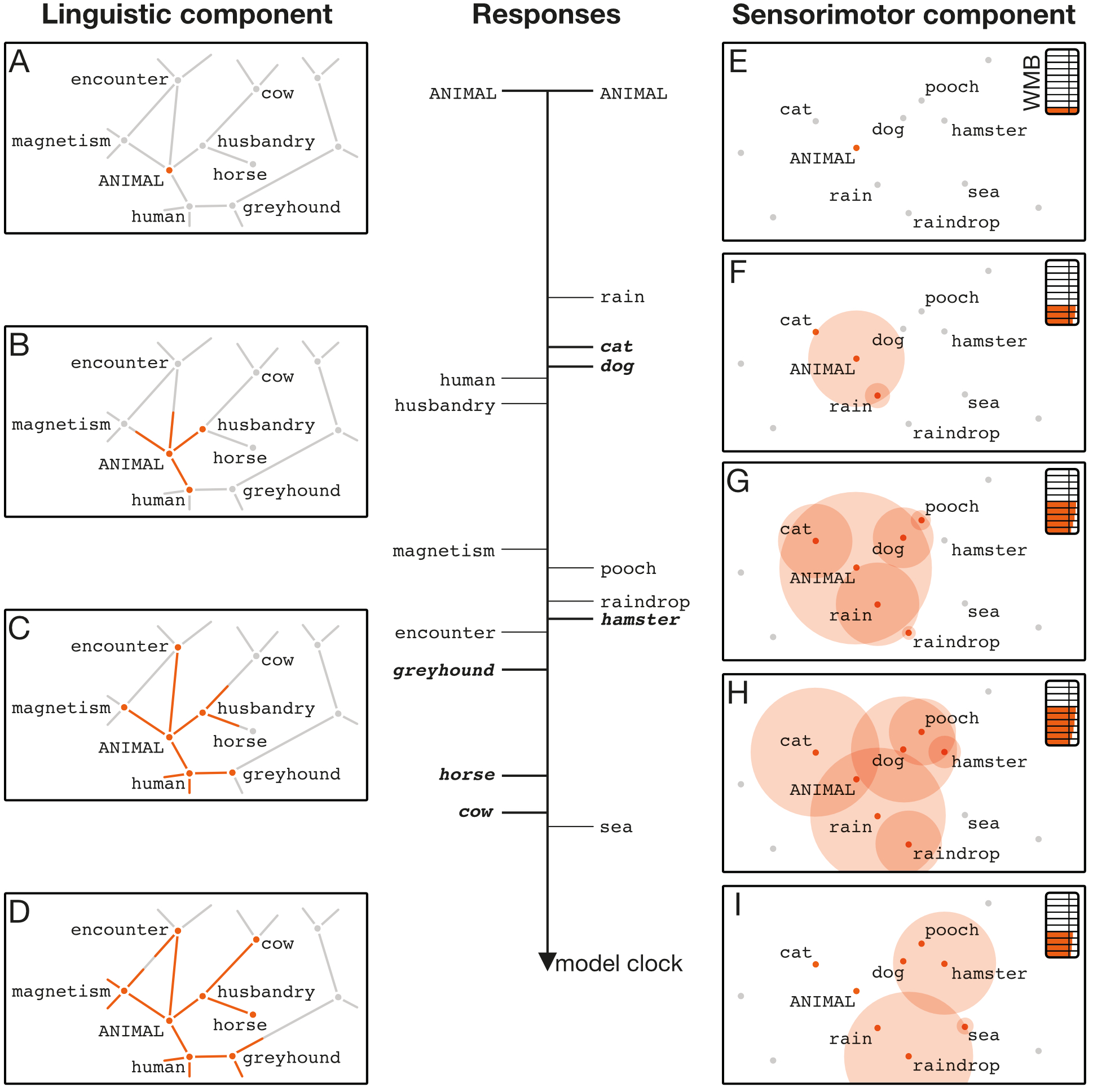
New paper in Language, Cognition and Neuroscience: Understanding the role of linguistic distributional knowledge in cognition
A paper on which I am joint-first author, which I previously posted here as a preprint, has just (after a long time!) been published in the journal Language, Cognition and Neuroscience.
It should be open-access, but if for some reason you can’t see it properly there, I can give you a copy.
New paper in Behavior Research Methods: Sensorimotor distance: A grounded measure of semantic similarity for 800 million concept pairs
A paper I co-authored with Professor Louise Connell as just been published in the journal Behavior Research Methods. I previously mentioned the preprint, and you can read more about the content of the paper on that post.
As usual, it should be open-access, otherwise there’s a copy over here.
New paper: Modelling implicit bias in gender–career associations: a systematic comparison of language models
A paper I co-authored has recently been published in the journal of Information Processing and Management, on the topic of the gender–career implicit bias.